
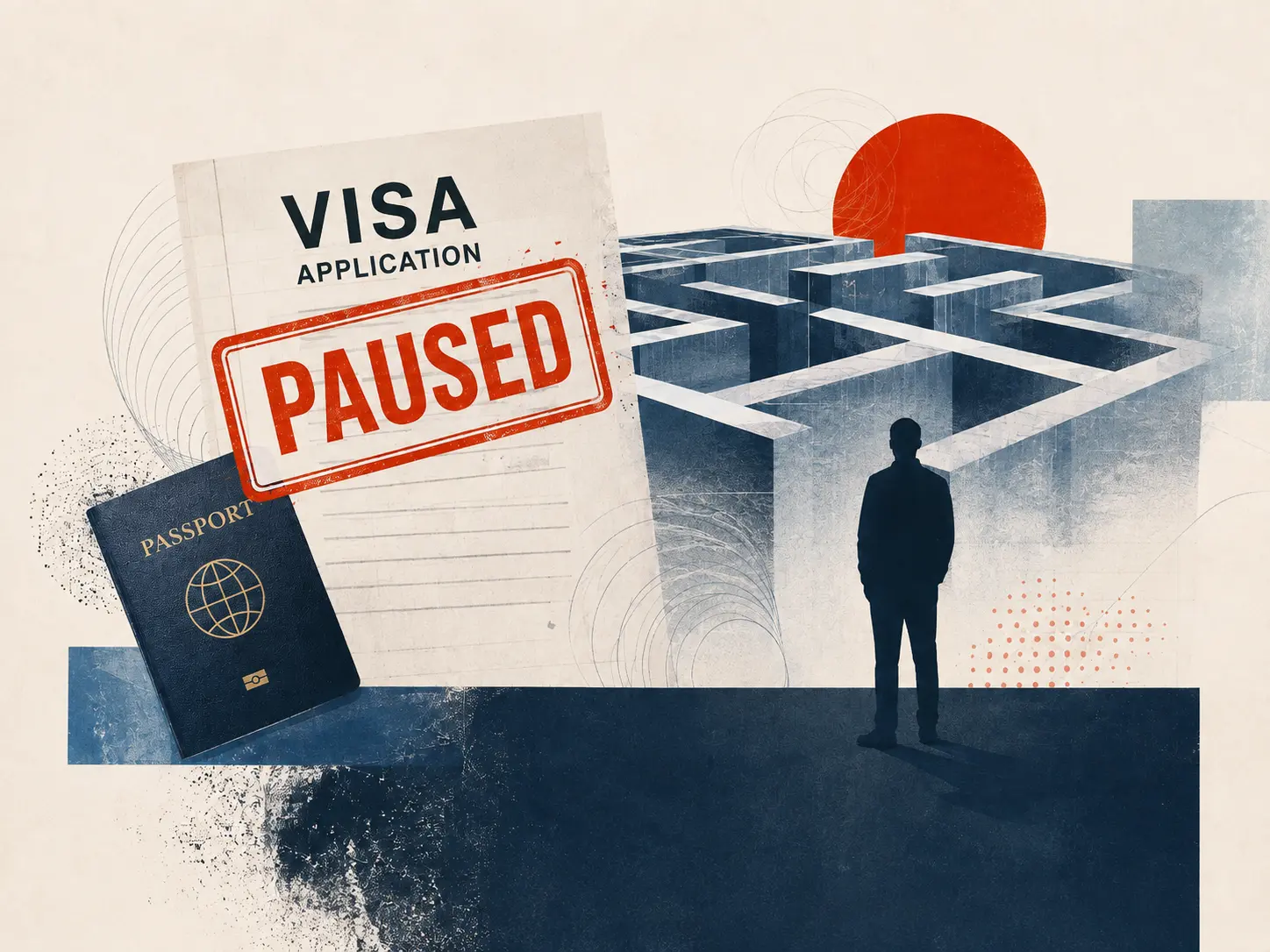
A few days ago, the legal and immigrant community was celebrating a court ruling that lifted the pause on consular processing for people from 75 countries. The celebration didn't last long. Barely 24 hours later, the government announced a new pause on consular processing, this time not just for those 75 countries, but for the entire world.
So what does this actually mean in practice? Let's break it down.
What is consular processing for an immigrant visa?
An immigrant visa is the process that eventually gets you a green card. This covers both family-based petitions and employment-based petitions.
This process always starts with USCIS, the federal agency that decides whether your family relationship or your employment petition has merit.
Consular processing only comes into play when the applicant is outside the United States. It's the step that happens at the embassy, after USCIS has already approved the petition, so the person can enter the U.S. as a resident.
So who does this pause actually affect?
- If your case is still with USCIS, this doesn't touch you. Zero impact on your case.
- If what you're seeking at the embassy is a nonimmigrant visa (tourism, study, investment), this doesn't affect you either.
- The people who will feel this, for the next few weeks, are those who already have an approved petition, whose category is current in the visa bulletin, and who already had an interview scheduled at the embassy. In other words, it's a pretty specific group, not everyone.
How long will this last, and why did they do it?
The official version, both for the 75-country pause and this new one, ties back to the new public charge rule. The government's theory is that people from those countries represented a higher risk of ending up dependent on government benefits.
With the public charge rule now in effect, the government says this pause is to "train staff on how to apply it." According to them, this should be resolved by mid-September and appointments will resume as normal. We'll see.
In the middle of the noise, we're here
A few months ago I told several clients that immigration these days feels like a minefield. You'd think that, heading into the second year of this administration, things would settle down a bit. They haven't. Every week brings something new: a different process, a suspension nobody saw coming, a new way of reading the rules.
At CALAM, we're here to help you walk through this maze. With me or with another attorney, what I can tell you is that right now is not the time to move forward without solid legal advice. Your future in the United States is worth too much to leave to chance.